
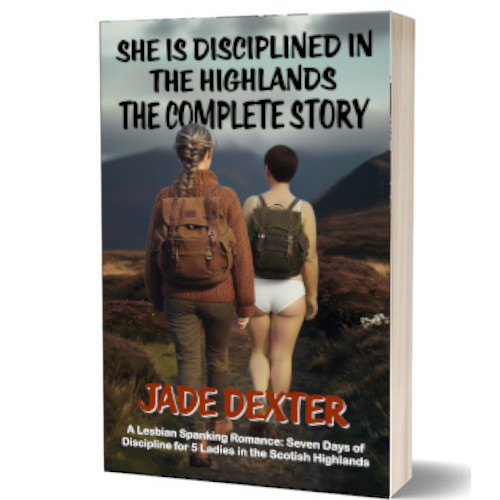
Moira MacLeod runs a wilderness programme for women in crisis. The courts send her difficult cases. Probation officers send her women who are heading for jail. Husbands send her wives they cannot manage. Desperate families send her daughters who are drowning. The official documentation describes the programme as wilderness survival therapy. Moira describes it more precisely as transformation through absolute authority, because that is what it is, and she stopped apologising for it years ago.
The stone cottage sits at the end of a narrow Highland road, isolated from everything that her students have been using to prop themselves up. There is no professional status here, no inherited privilege, no carefully maintained distance, no armour that the landscape will not eventually strip away. There is only Moira’s word, the mountains, and the consequences that come when her instructions are ignored. Those consequences are old-fashioned and immediate, and Moira takes genuine pleasure in every aspect of delivering them.
Five women arrive across this complete story, each one carrying a different kind of armour.
Sarah Winters is a London solicitor who has been running on control and overwork for a decade, sustained by the certainty that her sharp mind can argue its way out of anything. She is court-ordered to Moira’s programme after collapsing in chambers, and she arrives furious, impeccably dressed, and constitutionally incapable of following an instruction without disputing it first. The paddle comes out within the first hour. What Sarah discovers, face-down across Moira’s knee in that stone-floored cottage, is not only that someone has finally found a way past all her defences but that her own body’s response to that discovery is not what she would have predicted.
Jenny Morrison is twenty-four, from Glasgow, and facing prison. She arrives at the cottage radiating controlled fury and the particular defiance of someone who has spent years using aggression to keep the world at arm’s length. Moira has been told she is unsuitable for the programme. Moira said send her anyway. The discipline that Jenny receives on the hillsides and in the firelit cottage is harder than anything in the other books, because Jenny needs it to be, and the slow cracking of a woman who has never once let anyone close enough to hold her accountable is the emotional centre of her story.
Margaret Hughes is forty-five, a civil servant who has spent her entire professional life being impeccably competent and has just been told she is too valuable where she is to be promoted. She arrives prepared, her equipment list checked three times, having trained for a month. She does not need breaking down. She needs, with equal urgency, to discover what it feels like to be allowed to fail, to be corrected without catastrophe, to be held by someone firm enough that she can finally stop holding herself. Moira’s approach to Margaret is gentle by her standards. The discipline is no less explicit for it.
Catherine Ashford-Price arrives because her husband has sent her, paying double Moira’s usual rate, and expects Moira to teach Catherine her place. Moira has no interest in teaching women their place. What she does have is a deep, personal understanding of what inherited privilege does to a woman who has never once been required to do anything, and a very particular pleasure in watching that privilege dissolve in cold Highland rain, over a knee, face-down in heather, learning for the first time what it means to be accountable to someone who cannot be charmed or managed or dismissed. Catherine’s story is the sharpest and most confrontational of the five.
Ruth MacKenzie is twenty-eight and has been sent by her minister father who wants Moira to cure her of her attraction to women. Moira, who has been a lesbian since she was fifteen and spent twenty years in a passionless marriage before her husband’s death freed her, is not going to do that. Ruth’s week is the most tender of the five, an act of liberation rather than correction, though Moira’s methods remain exactly what they are. What Ruth has been taught to call sin, Moira teaches her to understand as self, and the discipline in this final book is the instrument of that teaching, every stroke given not to punish desire but to dismantle the shame that has been built up around it.
The Highland landscape runs through all five books with genuine authority, the granite hillsides, the peat-brown rivers, the mist and the cold and the kind of silence that strips a woman down to something essential. Moira is one of the most fully realised figures in erotic fiction of this kind: a woman who has constructed her life with care and intelligence around what she loves, who is honest about her desire, who is neither cruel nor soft, and who sees each woman who comes to her stone cottage with clear, unhurried attention. The discipline across these five stories is varied in severity and tone to match the woman receiving it, and the desire that runs beneath every correction is given room to develop and to be satisfied.
This book contains explicit F/F erotic spanking, hand spanking, paddle, belt, strap, tawse, and cane use, outdoor discipline, fingering, oral sex, orgasm denial and release, age gap dynamics, authority and surrender dynamics, restraint, forced arousal during punishment, multiple-session discipline arcs, lesbian sexual awakening, religious shame and liberation, full nudity, and graphic sexual content between consenting adults.



Reviews
There are no reviews yet.