
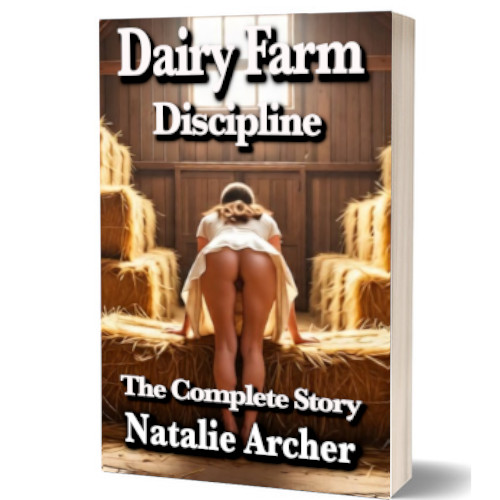
Three adult daughters have been running wild on a Welsh hillside farm since their father’s death, and their mother Gwyneth has tried everything she can think of that doesn’t involve pulling a hard-backed wooden chair to the centre of the kitchen. She has reasoned and pleaded and threatened, and none of it has worked. On a Tuesday morning, when her eldest daughter’s voice tips into contempt, she remembers what her own mother used to do, and what her grandmother did before that, and she stops trying to find a gentler answer.
What follows, daughter by daughter, is a reckoning. Megan at twenty-three is headstrong and secretly seeing a man her mother has forbidden; she goes over Gwyneth’s knee with her jeans and knickers down and comes away red-bottomed, shaken, and with a new understanding of where she stands. Bethan at twenty-one comes home after midnight drunk and defiant, and meets the back of a wooden hairbrush in the living room before the night is out. Elin at nineteen is the watchful one, the quiet one, the one who has never caused a moment’s trouble, and her encounter with her mother’s discipline is the most unexpected of all.
But the Powell farm holds more than three daughters. Mair is their neighbour: older, calmer, the keeper of a knowledge that mirrors and extends Gwyneth’s own. When Mair arrives and sees what has begun, she recognises it. She has seen it before, in her own family, passed down through the generations in the same way it has been passed down through the Powells. And she has things to teach that Gwyneth has not yet learned.
The story that follows takes the Powell women and Mair’s own daughter Catrin through a week of discipline, instruction, and revelation. Gwyneth must learn not only to give but to receive. Megan and Bethan and Elin, already brought to account in the farmhouse kitchen and living room, discover that accountability between women can take many forms, and that the hard-backed chair and the firm hand are the beginning rather than the end of what the tradition holds. Catrin, arriving uncertain and curious, surrenders to something she has never experienced and emerges from it changed. And Sian, quiet and careful, asks to become something more than a recipient.
The writing is warm and specific, set against a particular Welsh landscape that earns its place in the story: the forty-acre hillside farm, the Aga in the kitchen, the old farmhouse walls that are thin enough to hear through. The discipline throughout is explicit and unhurried, delivered with attention to what each woman actually needs, and the sexual charge between the scenes builds steadily into something the book satisfies fully by its end. The ritual of the circle and the generational journal tie the erotic content to a larger emotional argument: that this tradition is about trust and belonging as much as it is about pain and pleasure, and that the two are not as separate as they might appear.
This is a long, fully realised story rather than a sketch, one that moves through multiple characters with care and arrives at an ending that closes the circle it opened in the first chapter. The farmhouse, the women, and the tradition they carry are all given room to exist as real things, which makes what happens between them land with proportionate weight.
This book contains explicit F/F erotic spanking, maternal discipline, hand spanking, hairbrush, strap, cane, paddle, and small leather whip use, orgasm denial and release, fingering, use of implement handles for penetration, genital spanking, intergenerational discipline dynamics, group discipline, ritualistic spanking ceremony, full nudity, and graphic sexual content between consenting adults.




Reviews
There are no reviews yet.